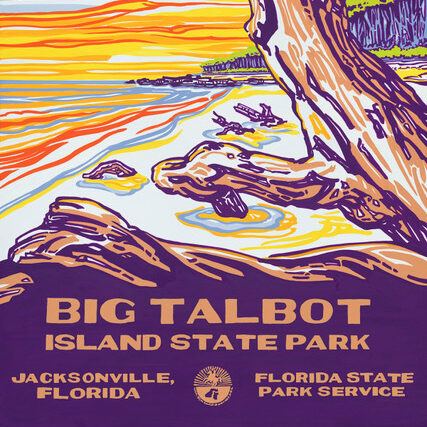
Art Exhibition and Reception
November 4, 2026
Angel Tree Gifts
November 18, 2026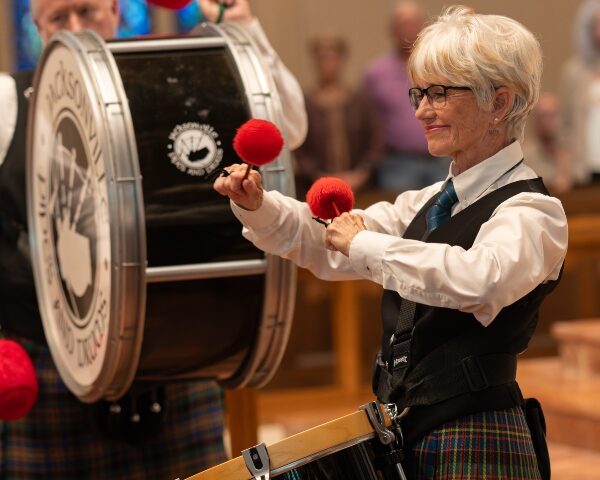
Most of us picture Evensong as a hushed service. Candlelight. A quiet choir. The day winding down. Our Evensong for St. Andrew begins a little differently. It begins with bagpipes.
Join us on Sunday, November 22 at 4 p.m. at St. John’s Cathedral as we honor St. Andrew, apostle and patron saint of Scotland.
An ancient way to end the day
Evensong is sung evening prayer. Christians have offered praise and prayer at the close of day for centuries. Nearly every word comes from Scripture. Psalms and canticles are woven together with readings from the Old and New Testaments, the Apostles’ Creed, and the Lord’s Prayer.
The choir sings on our behalf. That frees us to listen, to reflect, and to offer God our own thoughts and prayers.
Our St. Andrew Evensong keeps every one of these elements. What changes is the frame around them.
Not quiet, but still prayer
Evensong was never only about calm. Its main purpose is to proclaim the wonderful works of God. The Magnificat, sung at every Evensong, is a bold song. Mary sings of the mighty brought down and the humble lifted up. The psalms shout for joy as often as they whisper.
On St. Andrew’s Day, we let that joy spill out into the procession. The pipes gather us in and send us out. In between, the heart of Evensong remains. Scripture, song, and room to pray.
Who was St. Andrew?
Andrew was a fisherman from Galilee and one of the first disciples Jesus called. He is remembered as the one who brought his brother, Simon Peter, to meet Jesus.
Tradition holds that Andrew was martyred on an X-shaped cross. That cross, called a saltire, became his symbol.
Scotland tells a beautiful legend about it. Around the year 832, King Angus faced a larger army and prayed for help. A white saltire appeared in the blue sky above the battlefield. The king vowed that if he won, Andrew would become Scotland’s patron saint. He did, and the white cross on a blue field became Scotland’s flag.
St. Andrew’s feast day is November 30.
The music
The pipes. The Jacksonville Pipes and Drums open and close the service. They enter the Cathedral in procession playing Highland Cathedral by Michael Korb. It is a grand sight, and one you will not want to miss.
The preces and responses. The choir chants the setting by Martin Neary. Jen Meister serves as lay cantor. Neary has served as organist and director of music at both Winchester Cathedral and Westminster Abbey. He was also musical director for the funeral of Diana, Princess of Wales. His choral music for Evensong is widely respected and sung throughout England.
The canticles. The Magnificat and Nunc Dimittis come from Herbert Howells’ Gloucester Service. Howells wrote it in 1946 for Gloucester Cathedral, scored for four-part choir and organ. He knew that great building well. As a young man he studied with Herbert Brewer, the cathedral’s organist.
Howells once described the ecstasy he felt watching light flood through Gloucester’s great east window. Many hear that same light in this music. Howells set these two canticles about 20 times. The Gloucester setting is counted among his finest and remains one of his most loved. Listeners often describe his canticles as evocative and haunting. Come and hear for yourself.
Why flags and standards?
At the close of the service, the Brotherhood of St. Andrew serves as color guard for the Presentation of Flags and Standards. They bring forward four flags. The flag of the United States. Scotland’s Saltire, the white cross on a blue field. The Lion Rampant, the royal banner of Scotland’s kings. And the Union Jack. We sing God Save the King and Scotland the Brave.
Why flags at a prayer service? There are several good reasons.
The flag is a cross. Scotland’s Saltire is St. Andrew’s own cross. Carrying it forward is a way of honoring his witness and his martyrdom. The Union Jack carries his cross too, woven together with the crosses of St. George and St. Patrick.
A shared tradition. Many American churches hold a “Kirkin’ o’ the Tartan” service, often on or near St. Andrew’s Day. Families bring their tartans and banners forward to be blessed in thanksgiving for their heritage. Washington National Cathedral has hosted one every year since the 1950s. Our presentation shares that spirit. We give thanks for those who came before us and offer their gifts back to God.
Our Scottish roots. Episcopalians owe Scotland a special debt. In 1784, the first American bishop, Samuel Seabury, was consecrated by bishops of the Scottish Episcopal Church in Aberdeen. In a real sense, our church’s line of bishops runs through Scotland.
A fitting color guard. The Brotherhood of St. Andrew was founded on St. Andrew’s Day in 1883 at St. James Church in Chicago. Its first members pledged to follow Andrew’s example, who brought his brother to Christ. To this day, the Brotherhood keeps a rule of prayer, study, and service.
A familiar tune. Listen closely during God Save the King. Americans know the same melody as My Country, ‘Tis of Thee.
Come and see
Evensong for St. Andrew is a little bit pageant and a lot of prayer. Come early to catch the procession. Stay for the flags. And in between, let the choir carry your prayers as the day draws to a close.
Evensong for St. Andrew
November 22 at 4 p.m. at St. John’s Cathedral.
The pipers will play in the Bishop’s Garden after the service and all are welcome to enter Taliaferro Hall for a tartan-decked reception.